Feeding a cat seems simple: choose a food, put it in a bowl, and keep water available. However, a good feeding routine involves much more.
Age, body condition, amount offered, diet composition, meal frequency, water intake, individual preferences, and health status influence each cat's needs. At the same time, the location of bowls, routine organization, and weight monitoring can also modify the animal's experience.
In this area of ComGatos, we have gathered content to help you make more informed decisions about nutrition, water, and feeding routines.
There is no perfect diet for all cats.
A good diet needs to be suitable for the cat that is actually in front of us.
External source: the Global Nutrition Guidelines from the World Small Animal Veterinary Association (WSAVA) recommend individualized nutritional assessment, taking into account diet, body condition, muscle condition, life stage, and health.
Nutrition doesn't start with the brand
When someone asks for “the best cat food,” they usually expect to find a specific brand name. However, this question has an important limitation: an excellent food for one cat may not be the best choice for another.
For example, a growing kitten has different needs than a sedentary adult. Similarly, an elderly cat who is losing weight needs to be evaluated differently than an overweight adult.
Therefore, before comparing packages, we need to consider life stage, body condition, neutering status, amount actually consumed, treats, illnesses, and dietary preferences. In other words, the choice starts with the cat and only then moves to the product.
Featured Content
How to Choose Food and Encourage Water Consumption
See how to evaluate dry and wet foods, understand the concept of complete food, organize meals, control portions, and improve hydration opportunities.
Read the full guide →The first step is to know what is being offered
In Brazil, the regulation of the Ministry of Agriculture and Livestock (MAPA) differentiates categories of products intended for companion animals.
A complete food, for example, is formulated to fully meet the nutritional requirements of the animal for which it is intended. Treats, supplements, and certain specific foods, on the other hand, have other purposes.
Therefore, the appearance of the product or the word “pouch” does not determine if it can constitute the main diet. “Pouch” is just a type of packaging.
For Brazilian regulatory information, consult the animal feed area of the Ministry of Agriculture and Livestock (MAPA).
Life stage changes needs
The needs of a kitten are not the same as those of an adult. Likewise, aging can modify appetite, weight, muscle mass, and clinical needs.
Kittens
They are growing rapidly and therefore need complete food suitable for growth. This phase can also be useful for gradually and safely introducing different textures.
Adults
After growth, portion size, physical activity, and body condition become areas of special attention. Even a good food can result in excess energy when offered beyond what is needed.
Mature and senior
Some cats gain weight; others begin to lose weight or muscle mass. Therefore, individual condition remains more important than automatically choosing a product just because it says “senior”.
The 2021 AAHA/AAFP Feline Life Stage Guidelines organize care by life stage and include nutrition, weight, behavior, and prevention.
Weight is not just a number
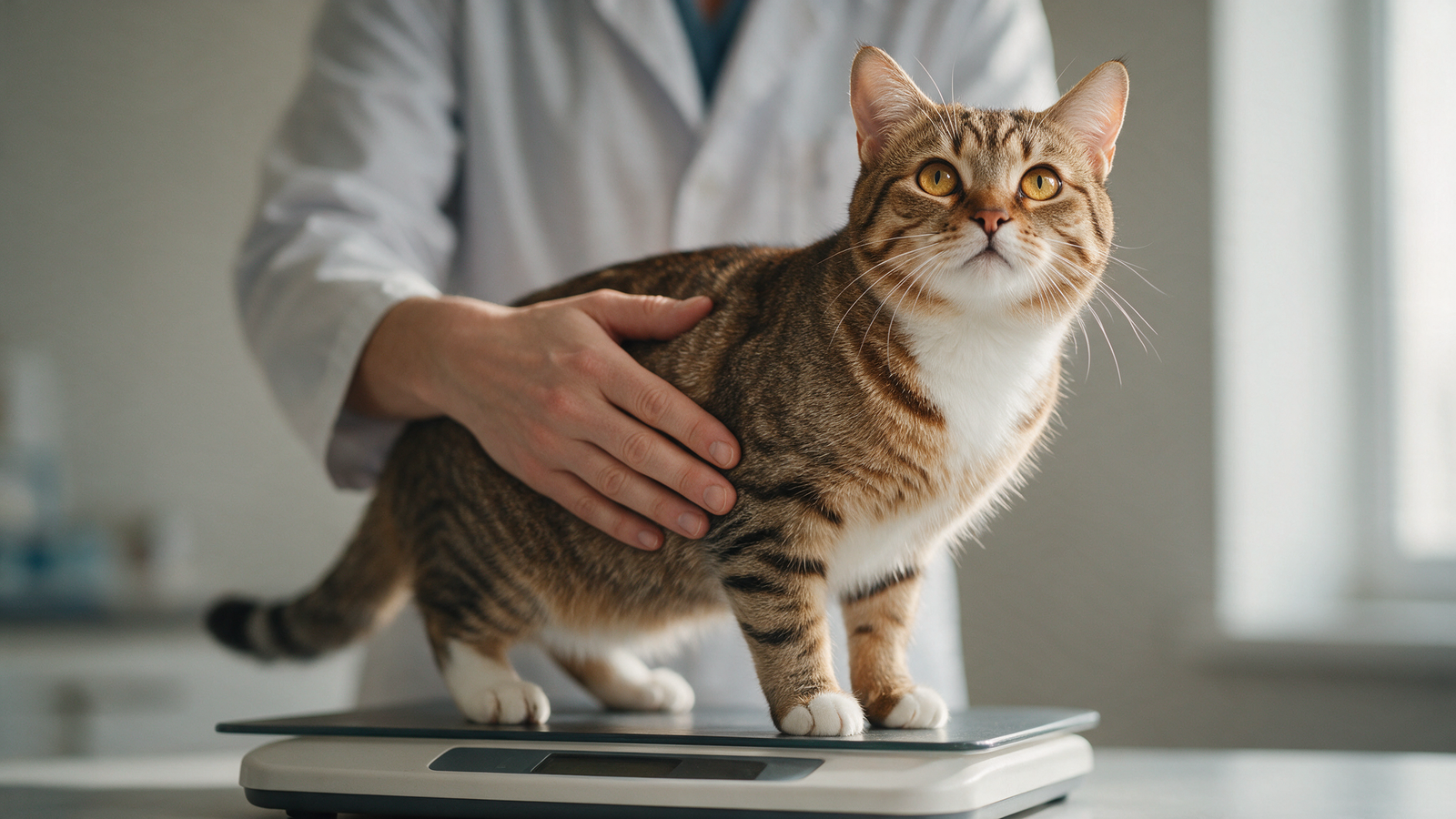
A scale provides important information. However, it doesn't tell the whole story. Two cats with the same weight can have very different amounts of fat and muscle mass.
For this reason, nutritional assessments can also use the Body Condition Score (BCS) and the Muscle Condition Score (MCS).
The trend over time also matters. For example, a sequence like 5.1 kg → 4.9 kg → 4.6 kg can be more informative than a single, isolated weighing.
The amount indicated on the packaging is a starting point
Feeding charts are useful. However, cats do not have identical metabolisms. Age, neutering, activity, body condition, and health interfere with the required amount.
Thus, the manufacturer's recommendation serves as an initial reference. Afterward, it's necessary to observe the results. If the cat gains weight progressively, the amount may need to be adjusted. On the other hand, unplanned weight loss warrants investigation rather than a simple increase in food.
Dry or wet food?
This question often elicits very absolute answers. However, complete dry and wet foods can be part of an adequate diet.
An important difference is the water content. Wet foods provide more water and, consequently, can contribute to increasing total water intake.
This does not mean, however, that it is correct to claim that dry food, by itself, causes kidney disease. Kidney and urinary health depend on multiple factors.
It's possible to combine dry and wet food
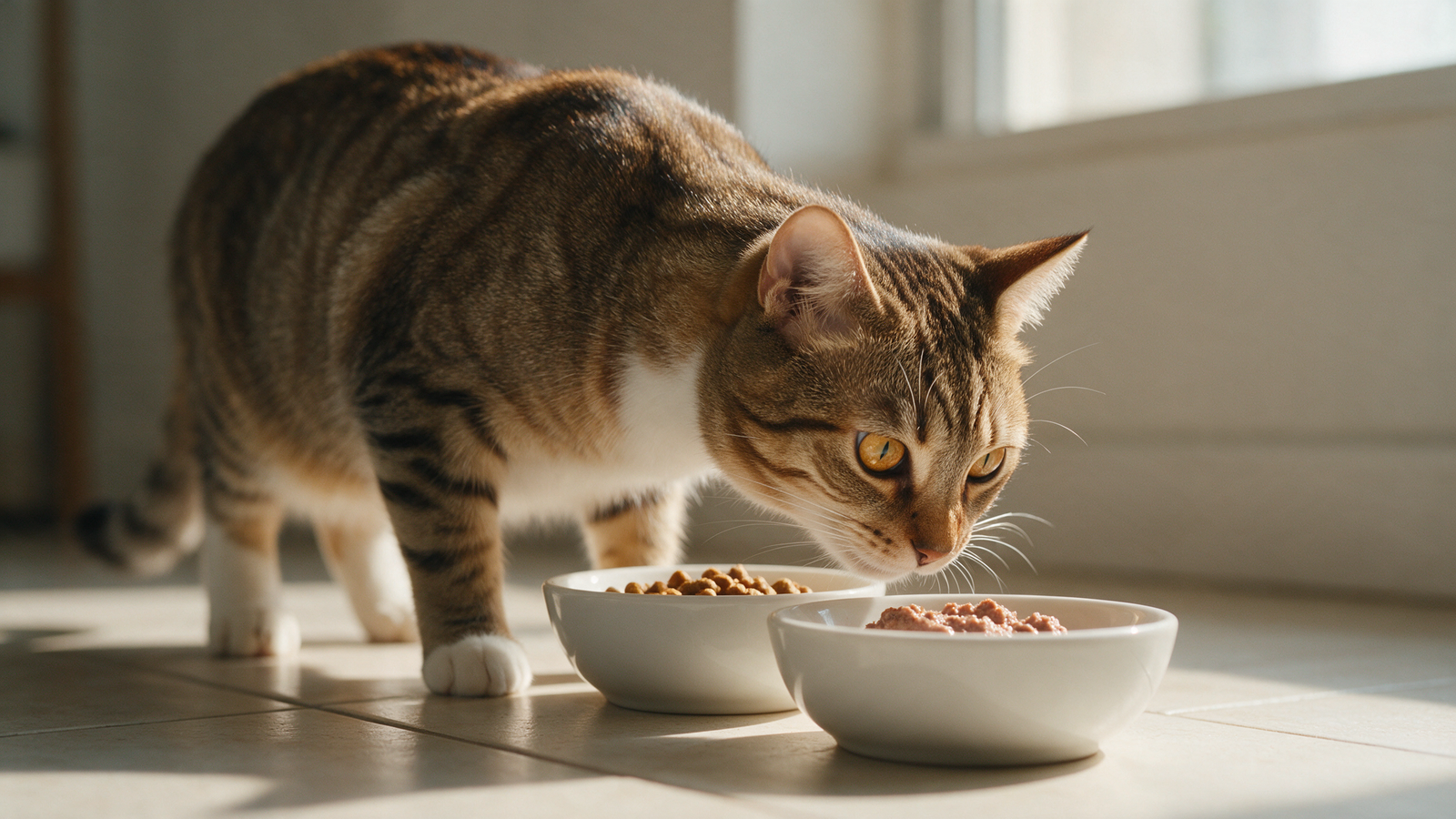
Yes. For many healthy cats, a routine can include both formats. For example, part of the daily energy can come from dry food and another part from wet food.
Calories add up.
If the complete daily amount of dry food is already being provided and sachets, treats, and other foods are still being given, the energy intake may exceed the cat's needs.
Hydration is not just what happens at the water bowl
When we think about hydration, we usually observe how much the cat drinks. However, part of the water also comes from food.
Thus, a cat that consumes a lot of wet food may drink less directly from the container and still receive an important amount of water through its diet.
On the other hand, a cat fed predominantly with dry food obtains proportionally less water through its food. Therefore, observing only how many times it approaches the bowl does not provide a complete measure of water intake.
The cat also has drinking preferences
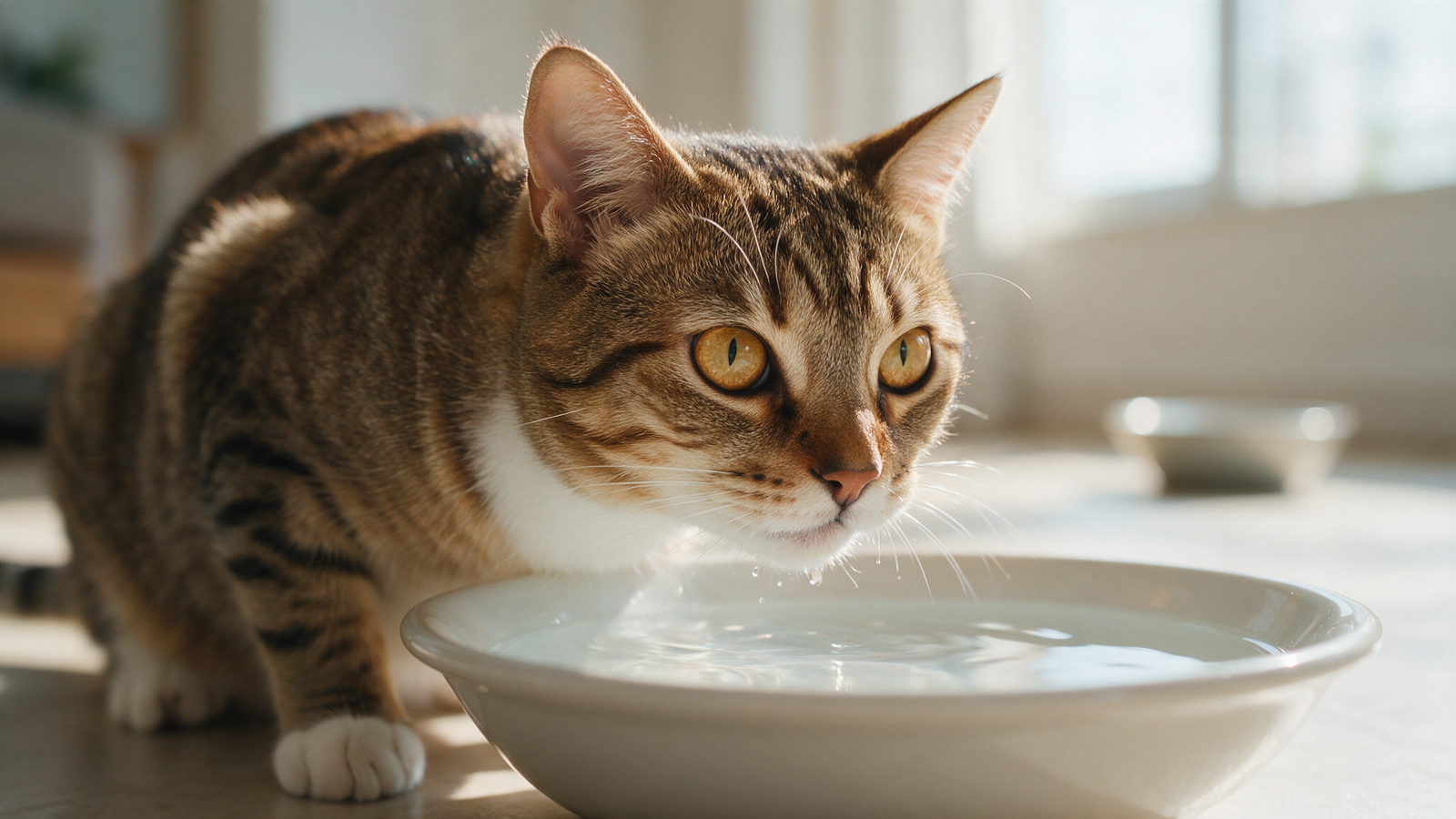
Water seems simple to us. For the cat, however, freshness, movement, location, material, and shape of the container can influence its choice.
- wider containers;
- different materials;
- distinct locations;
- stagnant water;
- moving water.
Still, we don't need to conclude in advance that a certain option will be superior. The cat's own behavior helps show which choices work best.
A water fountain can help — but it's not mandatory
Some cats really like running water. For them, a fountain can be interesting. Others, in contrast, practically ignore the equipment.
The fountain, therefore, should be seen as an option, not a universal necessity. Another essential point is maintenance: the reservoir, pump, and other components need to be cleaned.
A clean bowl is better than a sophisticated, poorly cleaned fountain.
Offer more than one drinking opportunity
Especially in larger homes or those with multiple cats, different water stations can facilitate access. However, three bowls placed side-by-side still function as a single station.
Therefore, when possible, distribute the containers throughout the environment. Water also doesn't need to be immediately next to food and should be kept away from elimination areas.
Eating together isn't always comfortable
In homes with multiple cats, placing all food bowls in a row might seem convenient. However, this doesn't mean everyone is comfortable.
One cat might wait for another to finish. Another might eat quickly for fear of losing access. It's also possible for one individual to control access to the bowls.
In this scenario, different feeding stations, separate rooms, visual barriers, or individual feeders can help. This makes it easier to reduce competition and understand how much each cat is actually consuming.
Smaller meals may make sense
Feline eating behavior naturally involves multiple small ingestions. This doesn't mean the owner needs to feed the cat continuously.
When the routine allows, dividing the daily amount can be beneficial. Automatic feeders or interactive feeders can also be considered in some cases.
Dividing meals does not mean increasing the daily amount.
Interactive feeders are an option, not an obligation
Interactive feeders can encourage exploration and foraging. Still, we shouldn't turn every meal into a challenge.
If the equipment is too difficult, the cat may become frustrated or simply eat less. Therefore, start with simple tasks and adjust based on age, mobility, health, and individual interest.
Treats are part of the equation
Treats are small. However, their sum can be large. Foods used to administer medication and pieces offered during human meals also count.
In other words, when evaluating energy intake and weight gain, we need to consider everything that provides calories.
Food changes should be planned
Some cats accept changes easily; others are quite selective. Abrupt changes can also cause refusal or gastrointestinal upset in certain animals.
Therefore, when there is no clinical need for a rapid change, a gradual transition is usually a good strategy.
Do not withhold food from the cat to force it to accept a new food.
Significant or persistent food refusal warrants veterinary attention.
Homemade diets require formulation
Preparing food at home does not automatically mean offering a healthier diet. Meat, rice, vegetables, and supplements chosen on your own may not provide adequate nutritional balance.
Therefore, when a homemade diet is to be used as the main food, it needs to be correctly formulated to meet the cat's needs. Free substitutions of ingredients can also significantly alter the outcome.
The ingredient list should not be the sole deciding factor
It is common to find food comparisons based solely on the first ingredients on the label. However, the list alone does not inform about digestibility, overall quality, quality control, formulation expertise, or final nutritional adequacy.
For this reason, it is worth analyzing the food more broadly and also considering information about the manufacturer and the processes used.
The manufacturer also provides important information
Some questions help to better evaluate a product:
- Who formulates the food?
- Is there quality control?
- Does the company provide technical information?
- Is it possible to get in touch?
- Who manufactures the product?
- Is additional nutritional data available?
In this way, attractive packaging becomes just a small part of the decision.
Changes in hunger or thirst deserve attention
A cat that starts drinking much more water is not necessarily "learning to hydrate better." Likewise, an animal that starts eating much more or much less may be showing a health change.
- weight loss or gain;
- increased urine output;
- vomiting;
- diarrhea;
- reduced activity;
- difficulty chewing;
- behavioral changes;
- loss of muscle mass.
A simple routine helps to notice changes
It is not necessary to turn feeding into a complex system. In practice, a consistent routine usually makes observation easier.
Thus, a routine is not just for feeding. It also creates a reference point. When something changes, it becomes easier to notice.
What to monitor throughout life
- weight;
- body condition;
- muscle mass;
- approximate amount of food;
- treats;
- type of diet;
- appetite;
- thirst;
- amount of urine;
- acceptance of new foods.
Adequate nutrition is a combination
There is no single bowl, format, or brand capable of summarizing feline nutrition.
A good routine combines nutritionally adequate food + compatible quantity + hydration + appropriate environment + monitoring of body condition and health.
Therefore, wet food should not be treated as a universal solution. Likewise, dry food should not automatically be treated as a problem.
One feeder can help one cat and be ignored by another. The most expensive food on the shelf is also not necessarily the best choice for a particular animal.
The goal is not to find the most sophisticated food. It is to build a safe, adequate, and sustainable nutritional routine for that cat.
Responsible information about feline nutrition
Nutrition is an area where absolute information circulates easily. Phrases like “this ingredient is always bad,” “every cat needs to eat this way,” or “natural is always better” oversimplify a complex topic.
Therefore, at ComGatos, our goal is to separate well-established nutritional principles from promotional claims, fads, or generalizations.
Whenever the cat presents illness, weight loss or gain, change in appetite, altered thirst, or need for a therapeutic diet, the recommendation must be individualized.
Feeding well also means observing, adjusting, and recognizing when it is necessary to seek veterinary guidance.
Veterinary review: Charles Nunes e Silva.
This content is for educational purposes and does not replace individualized nutritional or clinical evaluation. Cats with illnesses, persistent changes in appetite or thirst, weight loss or gain, or need for a therapeutic diet should receive veterinary guidance.